
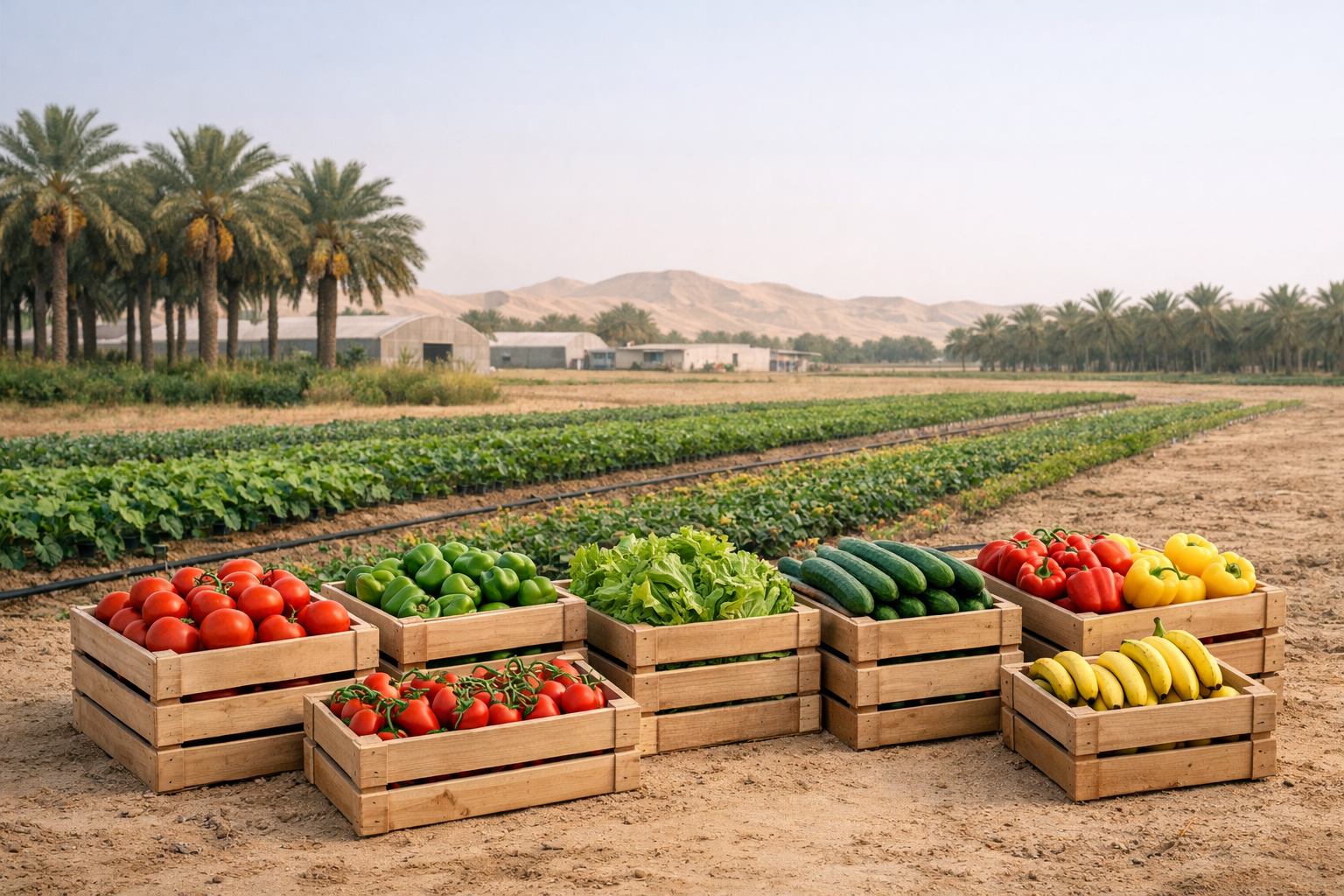
Harvesting the Impossible: How Technology is Turning Kuwait’s Desert into a Fruitful Oasis
In the hyper-arid heart of the Arabian Peninsula, where summer temperatures regularly breach the 50°C mark, the environment is essentially a war of attrition against biology. Kuwait’s landscape is defined by an evapo-transpiration rate that ranges from 3.0 to 14.1 mm per day—a staggering figure that dwarfs the country’s meager 110mm of annual rainfall. With 90% of the land considered non-arable and soil that is little more than thirsty sand, the notion of agricultural self-sufficiency was long dismissed as a desert mirage.
For decades, Kuwait accepted a 90% reliance on food imports as an immutable fact of geography. However, a tectonic shift in the geopolitics of caloric sovereignty is currently underway. Driven by the “New Kuwait 2035” vision, the desert is being reimagined not as a wasteland, but as a closed-loop laboratory for the future of the planet. Through “modern facility agriculture” and digital climate control, Kuwait is proving that technology can indeed rewrite the rules of what can grow in the sand.
The Great Banana Breakthrough: Halving Prices Through Ingenuity
The most vivid symbol of this transformation is found an hour’s drive south of the capital in Al Wafrah. Here, farmer Sari Al-Azmi has achieved the counter-intuitive: growing tropical bananas in one of the driest places on Earth. This is a story of exponential ambition; what began as a trial of just eight trees has exploded into a commercial operation of over 20,000 banana trees.
The catalyst for this success is “Alsini”—the Arabic word for China. Leveraging the deepening cooperation of the Belt and Road Initiative, Al-Azmi imported automated greenhouse systems from Guangzhou. These systems utilize fans and circulating water-cooling to maintain internal temperatures below 30°C, shielding the plants from the lethal external heat.
The economic implications are as refreshing as the cooling systems themselves. Traditionally, imported bananas reached Kuwaiti markets at approximately 0.6 KWD per kilogram. By producing them locally, Al-Azmi has slashed that price to 0.3 KWD.
“Our farming is not just for profit—it’s to serve the country we love.” — Sari Al-Azmi
His success has transformed his farm into a national landmark, proving that when high-tech equipment meets local passion, the desert can compete with global tropical exporters.
The High-Tech Sky Harvest: 90% Less Water, 100% Pesticide-Free
While Al-Azmi conquers the horizontal desert, others are looking upward. In 2019, Kuwait launched its first large-scale indoor vertical farm in partnership with &Ever. Spanning 3,000 square meters of farming space, this facility is a marvel of “Dryponics” technology. It represents a paradigm shift in resource management, utilizing 90% less water and 60% less fertilizer than traditional soil-based methods.
This “Farm to Fork” model is an exercise in hyper-efficiency, capable of producing up to 550 kilograms of greens, herbs, and cresses daily. These products reach retail shelves within just two hours of being harvested. From an insight perspective, the value is not just in speed, but in purity. Because the environment is digitally controlled—tracking CO2 levels, airflow, and temperature with surgical precision—the crops are 100% pesticide-free.
Crucially, this eliminates the need for “chlorine washing,” a standard practice for travel-worn imports that often degrades nutritional value. For the Kuwaiti consumer, the result is a superior, nutrient-dense product with a significantly longer shelf life, harvested in a facility that operates entirely independent of the harsh outdoor climate.
Date Palms: The Ancient Guardians of Tradition
Even as Kuwait embraces the “Sky Harvest,” it remains rooted in the cultural soil of the date palm. Occupying approximately 20% of the country’s cultivated land, these “Guardians of Tradition” are more than just a crop; they are a legacy. Cultivating them is an exercise in generational patience, requiring a four-to-eight-year wait before the first fruit appears.
In a clever synthesis of tradition and sustainability, many of these groves are now irrigated with tertiary treated sewage water, as noted by the FAO. To combat the nutrient-poor sandy soil, specialized potassium-rich fertilization and organic matter are applied annually. The date palm remains a resilient staple, standing as a bridge between ancient survival techniques and the hyper-modern complexes of the future.
Water Alchemy: Turning Wastewater into Growth
In an arid nation, water management is the most critical pillar of food security. Kuwait’s “Water Alchemy” relies on a sophisticated mix of non-conventional sources to sustain its greening efforts. With negligible renewable freshwater, the country manages a complex hydraulic cycle:
- Desalinated Seawater: A high-cost necessity where energy consumption for thermal processing can account for 50% of the water’s unit cost.
- Brackish Groundwater: Extracted from the Hasa and Kuwait group aquifers (specifically the Damman and Dibdibba formations), though overdrafting has led to a 200-meter decline in levels in some regions.
- RO-Wastewater: The Sulaibiya plant, one of the most advanced in the world, processes up to 425,000 m³ per day using Reverse Osmosis to provide high-quality irrigation water.
The existential challenge, however, remains salinization. Much of the supplemental irrigation water contains total dissolved salts between 3,000 and 8,000 ppm. Without advanced drainage and technological intervention, this salt accumulation threatens the long-term viability of the soil—a problem Kuwait’s futurists are racing to solve.
Beyond the Tomato: The Expanding Desert Palette
The lessons of the 2020 global supply chain collapse, exacerbated by the COVID-19 pandemic, acted as a wake-up call for Kuwait’s leadership. It accelerated a move beyond basic staples toward a diversified “agricultural complex.” Brands like Yasmin Farms are now successful in harvesting “impossible” crops, including citrus, dragon fruit, strawberries, figs, grapes, and even apples.
This expansion extends into specialized markets, such as the surging demand for fresh basil driven by a rise in home cooking. Even the sea is being domesticated in the desert; the Kuwait Institute for Scientific Research (KISR) recently reached a milestone by producing locally farmed shrimp weighing 20 grams. This was achieved through “Biofloc” technology, which recycles water without the need for antibiotics or chemicals, creating a sustainable loop that mirrors the vertical farms on land.
Conclusion: A Vision for 2035 and Beyond
As Kuwait pursues its “Vision 2035” to become a regional financial and trade hub, it recognizes that such an economic transition is only possible upon a foundation of food security. The transition from a 90% reliance on imports to a nation of climate-controlled complexes is no longer just a project; it is a necessity.
Digital environments and vertical farming are proving to be the definitive future for all arid nations. They represent the ultimate triumph of human ingenuity over environmental limits. As these local havens continue to expand, the choice for the consumer is increasingly clear: will you choose the travel-worn produce that has crossed oceans, or the hyper-local “farm-to-fork” alternative that was growing in a desert oasis just two hours ago?
References
Plant and Pot Co.: Date Palms: Guardians of Tradition in Kuwait’s Agriculture.
CABI Digital Library: Potential of protected agriculture in the Arabian Peninsula.
Xinhua: Chinese technology and equipment help Kuwaiti farmer turn desert into thriving agricultural haven.
FAO AQUASTAT: Kuwait Country Profile.
International Trade Administration: Kuwait Agriculture Market Intelligence.
Arab Times: Locally grown shrimp hits Kuwaiti market in food security milestone.
Arab Times: Kuwaiti farmers successful in growing fruit variety under controlled environs.
Daleeeel.com: Kuwait Agro partners with &Ever to exclusively distribute &Ever Kuwait fresh greens and herbs.