
Bananas in the Desert High-Tech Alchemy is Turning Kuwaiti Sand into Gold
The Mirage That Became Reality
In a nation where summer temperatures regularly breach 50°C and the soil is composed of up to 90% sand, agriculture was long considered a fringe endeavor. For decades, the desert silence was rarely broken by anything other than the wind, yet today, a new sound resonates across the Ahmadi Governorate: the rhythmic clank of steel frames and the hum of industrial cooling fans. Kuwait, a nation that has historically relied on imports for 90% of its food, is witnessing the impossible take root. In the heart of a hyper-arid wilderness, locally grown tropical fruits are appearing in markets—the first harvest of a high-tech revolution that is transforming one of the world’s most inhospitable climates into a strategic agricultural hub.
The Banana Milestone: Defying 50°C Heat
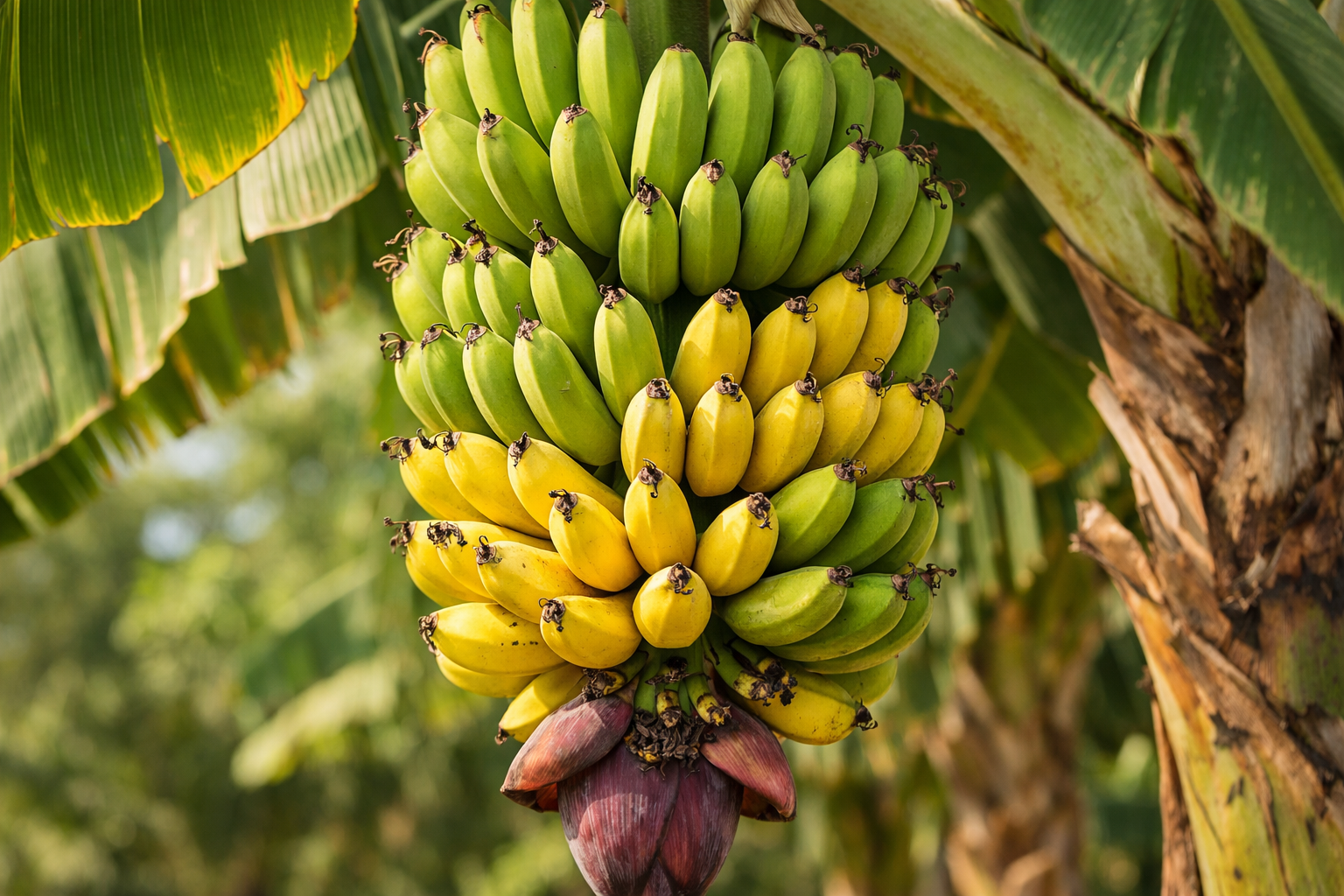
The Al Wafrah area recently witnessed an agricultural breakthrough that local media has termed a definitive “milestone.” In 2025, farmer Sari Al-Azmi successfully produced Kuwait’s first batch of locally grown bananas. Cultivating bananas in a region with negligible rainfall is inherently counter-intuitive; these are water-intensive tropical plants being grown in a land of dust.
Al-Azmi’s operation began as a modest trial with only eight trees. After proving they could flourish, he scaled with the precision of a seasoned developer. Today, his facility boasts more than 20,000 banana trees. But the revolution isn’t limited to bananas. His 85,000-square-meter farm has become a high-tech orchard for over 30 varieties of produce, including citrus, grapes, figs, pomegranates, and even exotic dragon fruit.
“Our farming is not just for profit—it’s to serve the country we love. Imported bananas sell for about 0.6 Kuwaiti dinars per kilogram, while our locally grown ones sell for 0.3 dinars. We’ve successfully halved the price. What makes our bananas unique is their freshness—they go straight from the farm to the consumer.” — Sari Al-Azmi
The “Alsini” Engine: How Chinese Tech Cooled the Desert
The engine driving this transformation is a deep geopolitical and technological partnership with China—referred to locally as alsini. This collaboration is a direct byproduct of the Belt and Road Initiative (BRI), which has facilitated a massive transfer of “facility agriculture” technology. For Kuwait, this represents a strategic pivot: a shift from traditional Western-centric technology dependency to an Eastern-aligned infrastructure model better suited for rapid, large-scale industrialization.
After discovering automated greenhouse systems at the Canton Fair in Guangzhou, Al-Azmi equipped his farm with over 200 Chinese-made greenhouses. These systems act as a technological shield:
- Automated Climate Control: Utilizing specialized fans and circulating water-cooling systems discovered in China, these facilities maintain internal temperatures below 30°C, even when the external desert heat hits 50°C.
- Heavy Infrastructure: From automated steel frames to electric tricycles and drip irrigation, Chinese equipment has become the standard. According to the Kuwaiti Farmers’ Union, the vast majority of the 7,500 large-scale farms in Kuwait now utilize this alsini hardware to bypass the limitations of the local climate.
Vertical Farming: The 90% Water-Saving Miracle
While greenhouses protect against heat, vertical farming addresses the more existential constraint: water. In 2019, the partnership between &ever and Kuwait Agro launched the nation’s first large-scale indoor vertical farm. Utilizing “Dryponics” technology, this 3,000-square-meter facility has redefined “Supply Chain Resilience” in the Middle East.
This facility produces 250 varieties of greens and herbs with staggering efficiency:
- Resource Management: It consumes 90% less water and 60% less fertilizer than traditional methods, requiring zero pesticides.
- Nutritional Integrity: Most imported produce is washed in chlorine, chilled, and packed for long-haul flights, losing significant nutritional value before it reaches Kuwaiti shelves. The &ever “Farm to Fork” model delivers produce from the farm to the consumer within two hours, ensuring peak flavor and vitamin density.
Water Alchemy: Turning Wastewater into Wealth
In a land where internal renewable water is a negligible 0 billion m^3/yr, Kuwait has been forced to practice a form of modern alchemy. Traditionally, the country relied on seawater desalination, a process where fuel consumption can account for 50% of the water’s unit cost. To break this energy-intensive cycle, the nation is creating a “virtual river” through reclamation.
With over 90% of the population connected to a central sewerage system, Kuwait produces roughly 250 million cubic meters of treated wastewater annually. The centerpiece of this strategy is the Al Solaybeia plant, recognized as one of the world’s largest and most advanced Reverse Osmosis (RO) wastewater facilities. By treating effluent to advanced irrigation standards, Al Solaybeia turns urban waste into the lifeblood of the desert, providing a sustainable, cost-effective alternative to expensive desalinated water.
The Economic Flip: Halving the Price of Freshness
What was once viewed as a “hobby” for the wealthy is now a calculated Import Substitution Strategy. Agriculture in Kuwait is unique; most farm owners are savvy investors with diversified income streams who view “facility agriculture” as a capital-intensive strategic investment.
The economic proof is in the pricing. By bypassing the volatile global supply chains and high carbon costs of air-freighted produce, local high-tech farms have successfully competed on cost. The local banana, priced at 0.3 KD versus the 0.6 KD for imports, is a definitive victory for domestic production. This shift is a central pillar of Kuwait Vision 2035, where food security is no longer an afterthought but a requirement for national stability and economic diversification.
Conclusion: A Future Grown on Innovation
Kuwait’s agricultural evolution serves as a global blueprint for arid regions grappling with climate change. By integrating the Belt and Road technological pipeline, world-leading RO-wastewater reclamation, and the vertical farming expertise of firms like &ever, Kuwait is proving that extreme environments are no longer absolute barriers to self-sufficiency.
The transformation of Al Wafrah and Al Abdali from barren sands into lush, productive hubs is a testament to the power of human ingenuity. If we can grow bananas, dragon fruit, and fresh greens in the heart of the Arabian desert, what other “impossible” barriers are waiting to be broken?